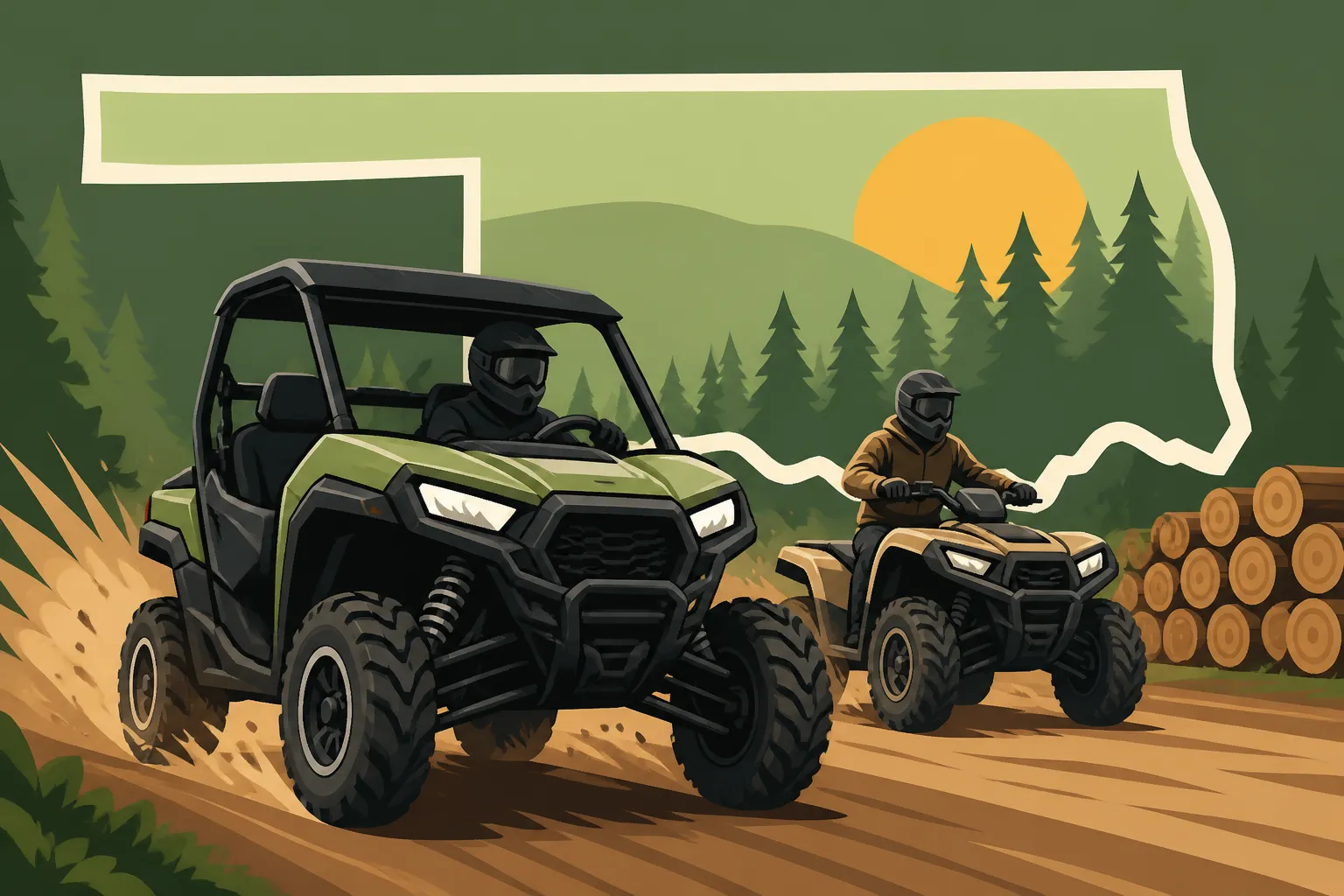
25 mph on Timber Company Roads
Timber company roads in Oklahoma can feel open and quiet, but they are working roads, not private trail loops. A 25 mph limit is a ceiling, not a safe speed in every condition. Knowing when to slow down, which roads you may use, and what access rules apply helps you avoid a dangerous encounter or a citation.
What the 25 mph limit means on timber company roads
On timber company land open to riding under Oklahoma’s access arrangements, the stated maximum speed on roads is 25 mph. Treat that as an upper limit, not a speed to maintain. Dust, loose gravel, washouts, blind curves, wildlife, and other road users can make a much lower speed the sensible choice.
The rule matters because these routes serve more than recreational riders. Timber trucks, pickups, hunters, land managers, and other permitted users may be on the same road. A large truck needs more room to stop and turn than an ATV does, and its driver may not see a machine coming through a cloud of dust. Keeping your speed down gives both of you more time to react.
A posted sign may set a lower limit or restrict access to a road. Follow the signs and any current directions from land managers; the general 25 mph maximum does not give you permission to ignore a closure or ride a road marked for a different use. If you cannot see far enough to stop safely, slow down. On a narrow or unfamiliar road, that may mean traveling well below 25 mph.
Keep the speed limit separate from the rules about where and when you can ride. A permitted speed does not authorize cross-country riding, entry onto a closed road, or access outside the allowed riding period. For the broader access requirements, see Oklahoma Timber Land Access Rules and Designated Roads Only on Timber Land.
| Situation | Practical response |
|---|---|
| Clear road with good visibility | Stay at or below 25 mph and be ready to slow |
| Dust, loose gravel, mud, or standing water | Reduce speed until you can stop within the visible distance |
| Blind curve, hill crest, or narrow bridge | Approach slowly and expect someone on the other side |
| Truck, grader, or other work vehicle ahead | Give it room, avoid its dust, and do not pass unless it is clearly safe and allowed |
| Roadside sign sets a lower limit or closes access | Follow the sign rather than relying on the general maximum |
A useful rule of thumb is to ride at a speed that lets you stop in the portion of road you can actually see. That matters especially when dust from a machine ahead hides the surface. Riding faster than visibility allows can leave you with too little time to avoid a pothole, stopped vehicle, or animal.
Why timber roads need a slower approach
Timber company roads change with weather and work. A route that was smooth on a previous visit may have fresh gravel, ruts, soft shoulders, standing water, or heavy equipment on it. After rain, clay can become slick; during dry spells, loose dust can reduce visibility. The posted maximum does not account for every one of those conditions, so riders need to adjust continuously.
Dust and limited visibility
Dust is not just a nuisance. It can hide a vehicle, obscure a turn, or make it hard to judge how quickly you are approaching another rider. Leave enough space that you are not riding directly in the dust cloud ahead. If visibility drops, slow down and increase following distance. When you cannot see the road surface or what is ahead, stopping somewhere safe is better than continuing at speed.
Work traffic and road edges
Timber roads may be used by trucks and equipment that are wide, heavy, or slow to turn. A road can also have a soft shoulder or a ditch close to the travel surface. Do not assume you can pull off anywhere to let a truck pass. Look for a firm, safe place, communicate your intentions, and give the larger vehicle room.
On a curve or narrow section, avoid trying to squeeze past another vehicle. If you meet a truck, slow down early and follow the other driver’s directions when appropriate. Never assume that a work vehicle can stop quickly or move aside without risk.
Groups and following distance
A group ride can stretch out more than expected, particularly when riders have different machines or experience levels. Keep enough space to react without crowding the person ahead. Avoid sudden stops in a line of riders, and make sure the last person knows where the group is turning. The lead rider should not use the speed limit as a pace target simply because the road is open.
If the group is large, agree on a conservative pace before setting out. That makes it easier for less experienced riders to keep up without taking risks and reduces the chance that someone will speed to close a gap.
Speed is only one part of access eligibility
Timber company land is not automatically open to every rider at every time. Access can depend on permits, season, eligible roads, and the purpose of the visit. The rules for riding this land are different from ordinary public-road rules, and a registration decal or a permit from another state should not be assumed to meet Oklahoma land-access requirements.
Check the current requirements before traveling, particularly if you are visiting from outside Oklahoma. The details can depend on residency and the area you plan to use. Oklahoma Resident vs Nonresident Permits explains the permit distinction, while Does Oklahoma Recognize Another State’s ATV Decal? addresses why an out-of-state decal and land access are separate questions.
Timber land access is also tied to a limited riding window. The published guidance for these areas identifies a seasonal period, and access may be restricted outside it. Confirm the dates and any current closures before you leave; do not rely on a past trip or an old map. See October to January: The Timber Land Riding Window and Why Machines Come Off Timber Land After January 15 for related seasonal details.
In addition, some timber-land riding rules require a deer license, even when a rider’s immediate purpose is not to hunt. Do not infer eligibility from the fact that a friend has a permit or that a machine has an Oklahoma registration decal. Verify the current requirement for your status and destination using Riding Timber Land Requires a Deer License Too.
Before setting out, check the rules for the specific area, the permit needed for your residency, the dates when riding is allowed, and which routes are open. If you are unsure whether a road is designated for riding, do not treat the absence of a gate as permission. Use official maps or ask the land manager or appropriate agency before entering.
A practical way to ride timber roads safely
Planning ahead makes it easier to follow the speed rule without turning every ride into a guess. A quick check before leaving can prevent a long drive to a closed area or a confusing discussion at a road junction.
- Confirm access and permit requirements. Check that your permit applies to the area and to your residency status. Keep proof available in the form accepted for the site; Showing a Land Access Permit on Your Phone covers one practical question riders have about carrying proof.
- Check seasonal dates and closures. Look for current notices before you depart, especially after severe weather or during hunting activity. A road that appears on an older map may not be open now.
- Review the designated routes. Plan to remain on roads authorized for riding. Do not use an unmarked path or turnoff as a shortcut unless current rules clearly allow it.
- Set a pace below the maximum when conditions call for it. Agree that 25 mph is the ceiling, not the group’s required speed. Reduce speed for dust, poor visibility, road damage, traffic, or unfamiliar terrain.
- Make the machine visible and predictable. Use appropriate lighting when conditions require it, keep a safe gap, and avoid weaving between road users. Be especially cautious near bends, hill crests, and intersections.
- Recheck rules when plans change. If the group moves to another area or a route is closed, stop and verify access rather than assuming the same permit or route rules apply.
Do not let a familiar route make you complacent. Road maintenance and work activity can change between visits, and a quiet road can become busy with little warning. The safest approach is to assume that a truck, another rider, or a road hazard may be just beyond the part you can see.
If you are traveling from another state, treat reciprocity as a separate question from road speed. A plate or decal recognized for operating a machine does not necessarily provide land access, and a land access permit does not replace the machine’s registration obligations. Confirm both before riding. If you are new to the process, Where to Buy a Land Access Permit can help you identify the next step.
Common mistakes riders can avoid
The most common misunderstanding is treating 25 mph as a recommended cruising speed. It is only a maximum. If dust, road surface, traffic, or visibility makes that speed unsafe, slowing down is the right choice.
Another mistake is assuming a road is available because it looks public or because another rider is using it. Timber roads may be private working routes with access conditions. Stay on designated roads and follow signs even when no one is present to enforce them.
Riders also sometimes focus on the permit and forget to check timing. A valid permit does not necessarily mean the land is open for riding on every date. Seasonal restrictions and temporary closures still matter. Likewise, an Oklahoma registration decal does not by itself establish access rights on timber company land.
Finally, avoid tailgating in dusty conditions. A machine ahead can hide a stopped vehicle, a rut, or a turn. A larger gap gives you room to slow down without forcing the riders behind you into sudden braking. When a road is too dusty to see clearly, wait for conditions to improve or choose a safer route that is open to you.
Disclaimer
This article is for general informational purposes only and does not constitute professional advice. Laws, prices and regulations vary by location and change over time. Consult a qualified professional for guidance on your specific situation.