Oklahoma Registration for a Dirt Bike
Let's face it, trying to figure out the rules for dirt bikes in Oklahoma can feel like navigating a maze blindfolded. You've got two wheels, an engine, and a thirst for trails, but the state's motor vehicle laws weren't exactly written with your specific passion in mind. This guide is here to cut through the confusion and explain exactly how Oklahoma handles the registration and titling of your dirt bike, whether it's destined purely for off-road adventures or you're dreaming of a street-legal conversion.
The Core Distinction: Off-Road vs. Street-Legal
The very first thing we need to wrap our heads around is that not all dirt bikes are treated equally under Oklahoma law. While they might all look similar when caked in mud, their legal status hinges on whether they are strictly for off-road use or if they've been equipped and permitted for public road travel. This fundamental difference dictates everything from how you register it to what kind of fees you'll pay.
Why Dirt Bikes Are Different from ATVs/UTVs
It's easy to lump all off-road vehicles together, but dirt bikes have their own unique place. Unlike the robust, multi-wheeled ATVs and UTVs, dirt bikes are two-wheeled machines designed for agility, speed, and navigating challenging terrain. Their lightweight frames, long-travel suspension, and knobby tires are optimized for dirt, sand, and mud, not asphalt. Because of this, they don't always fit neatly into the "all-terrain vehicle" or "utility vehicle" boxes that cover quads and side-by-sides. While they share the spirit of off-road adventure, their mechanical configuration and how they interact with the ground can lead to distinct legal interpretations. For instance, the discussion around passenger limits or stability can be quite different for a single-rider dirt bike compared to a two-up ATV or a four-seat UTV.
Often, the default assumption is that if it's off-road, it's just like an ATV. But the historical development of vehicle laws meant that two-wheeled machines often had their own specific clauses, long before the popularity of side-by-sides. This means you might encounter slight variations in what paperwork is asked for or how certain exemptions apply. It's not about making things complicated, but rather acknowledging the distinct engineering and use cases that set dirt bikes apart, even within the broader off-road family.
When Does Oklahoma Consider a Dirt Bike an ATV?
For many practical purposes, especially concerning off-road registration, Oklahoma tends to group dirt bikes with ATVs and UTVs under a broad "off-road vehicle" definition. This is good news because it means a lot of the simpler, less burdensome registration rules that apply to quads also extend to your two-wheeled companion. The state understands that these vehicles are primarily used on private land, dedicated trails, or in designated off-highway vehicle areas, not on city streets or state highways.
However, it's crucial to understand that while they might be grouped for registration, they are still distinct vehicle types. This grouping primarily affects the initial registration process and the fees involved. For example, the requirement to have a title, and the method of obtaining one, can be quite similar. The goal of this grouping is largely for identification purposes by law enforcement and state park officials, making it easier to track ownership and ensure compliance when these machines are used on public lands. So, when you head to the tag agency, expect that the clerk will likely process your dirt bike with forms and procedures that feel very familiar to someone registering an ATV or a UTV, especially when it comes to the crucial initial titling step.
Understanding Oklahoma's Off-Road Registration Rules for Dirt Bikes
If your dirt bike is purely an off-road machine, never intended for public roads, the registration process in Oklahoma is surprisingly straightforward and, dare I say, quite user-friendly. It's designed to be a one-time event, rather than an annual hassle, which is a welcome relief for many riders who just want to hit the trails without endless bureaucracy.
The Basics: What Oklahoma Requires (and Doesn't)
For a dirt bike that will exclusively be used off public roads – on private land, dedicated trails, or at places like Little Sahara State Park – Oklahoma requires a one-time registration. This is a crucial distinction. Unlike cars or street motorcycles, you won't be dealing with annual renewal notices or recurring fees. Once it's registered, it's registered for the lifetime of your ownership in Oklahoma. The cost for this is incredibly modest, set at just $11. That's right, eleven dollars, and you're good to go. This one-time fee covers the administrative costs and provides you with a registration decal that identifies your machine.
It's important to understand that this registration isn't about giving you permission to ride on public roads. Its primary purpose is for identification, especially when using state-managed OHV areas, or in the event of theft or an accident where ownership needs to be verified. Think of it as a permanent ID for your off-road machine. You'll receive a decal, which typically goes on the front of your dirt bike in a visible location. For more details on this unique system, you can check out [Oklahoma ATV Registration You Pay Once] and [Oklahoma Registration Never Renews]. This permanent registration model is a huge perk for Oklahoma riders, saving both time and money over the years.
Essential Paperwork for a Dirt Bike
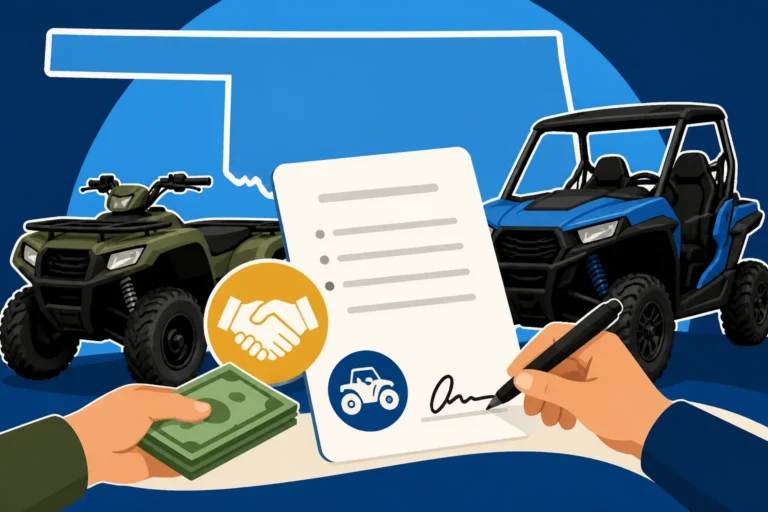
When you're ready to register your dirt bike, having the correct paperwork is paramount. Just like any other vehicle, the process hinges on proving ownership. For a brand-new dirt bike purchased from a dealership, the most important document you'll receive is the Manufacturer's Statement of Origin, or MSO. This is essentially the birth certificate of your bike and is critical for the initial titling and registration. The MSO establishes the first owner and provides all the necessary technical specifications of the machine.
If you're buying a used dirt bike, particularly an older model, a proper bill of sale becomes your key document. This needs to clearly state the buyer, seller, purchase price, date, and most importantly, the Vehicle Identification Number (VIN) of the dirt bike. While a simple handwritten note might seem sufficient, it's always safer to use a comprehensive template. Services like LawDepot offer templates that can help you create a legally sound bill of sale, ensuring all the necessary information is included to avoid headaches at the tag agency. For older machines, especially those from before specific cutoff dates for ATVs, Oklahoma has provisions for registering them even if a traditional chain of title isn't available, recognizing that not all historical off-road machines have pristine paperwork trails. You can learn more about this in [Oklahoma Bills of Sale for Older Machines] and [Oklahoma Skips Chain of Title for Old Machines]. Always ensure the VIN on the bill of sale matches the physical VIN on your dirt bike exactly.
Titling a Dirt Bike in Oklahoma
Yes, your dirt bike needs a title in Oklahoma, just like an ATV or UTV. This is a separate, but often concurrent, process with registration. The title is the official proof of ownership, a document that you'll keep safely filed away. When you go to a tag agency, they will process both the title and the initial registration at the same time, assuming you have all the necessary documentation. This ensures that your ownership is officially recorded with the state.
Unlike some states where off-road vehicles might not be titled, Oklahoma has made it a requirement for all ATVs, UTVs, and dirt bikes. This helps prevent theft and facilitates the legal transfer of ownership when you eventually sell your machine. There aren't specific "cutoff dates" for dirt bikes in the same way that 2005 and 2008 dates apply to ATVs and UTVs for certain excise tax exemptions. However, the general rule is that if you purchase a machine, it needs to be titled. The process involves filling out the standard vehicle title application, along with your MSO or bill of sale. For a broader understanding of how this works, check out [Oklahoma Titles ATVs and UTVs]. This title, once issued, is permanent until you sell the machine and transfer ownership to a new buyer.
The Exception: Street-Legal Dirt Bikes in Oklahoma
While most dirt bikes are built for the trails, some riders have a desire to make them street-legal. This is where things get considerably more complex and expensive. Converting a dirt bike for road use means transforming it from a pure off-road machine into a road-worthy motorcycle in the eyes of the law, and that entails a whole new set of rules and requirements.
Converting a Dirt Bike to Street-Legal
Making a dirt bike street-legal in Oklahoma isn't as simple as slapping a license plate on it. It requires a significant investment in parts and labor to meet the state's equipment standards for motorcycles. You'll need to install a proper headlight (with high and low beams), a taillight with a brake light, turn signals on both the front and rear, mirrors on both sides, and a working horn. Additionally, it must have a speedometer, an odometer, and a license plate holder with illumination. These components are essential not just for legal compliance, but for safety when sharing the road with other vehicles.
Many aftermarket kits exist to help with this conversion, but it's crucial that all installed components meet Department of Transportation (DOT) standards. The process essentially reclassifies your dirt bike as a motorcycle, subjecting it to all the same rules and regulations that apply to any street-legal motorcycle. This can be a challenging endeavor, as some frames or electrical systems on dirt bikes aren't easily adaptable to these requirements. While the focus here is on dirt bikes, the principles of what's required often mirror the stringent demands for street-legal UTVs. For a point of comparison, you might find it helpful to look at [Oklahoma Street-Legal UTV Requirements] to understand the level of detail involved in road conversions.
Annual Registration for a Street-Legal Dirt Bike
Once your dirt bike has successfully been converted to meet street-legal standards and passed any required inspections, its registration status completely changes. Gone are the days of the one-time, $11 fee. A street-legal dirt bike is treated as a regular motorcycle. This means it will require annual registration renewal, complete with yearly fees and a new decal or plate each year. The costs associated with this annual renewal will be comparable to those for any other street motorcycle in Oklahoma, varying slightly based on factors like the bike's age and value.
Furthermore, driving a street-legal dirt bike on public roads will necessitate proof of financial responsibility, meaning you'll need to carry motorcycle insurance. Unlike the off-road registration where insurance is generally not mandated by the state, for street use, it's non-negotiable. You'll also need a valid driver's license with the appropriate motorcycle endorsement. This is a significant shift from the simplicity of off-road registration. For an idea of how annual plates work for other vehicle types, you can check out [Oklahoma Annual Plates for Street UTVs], but remember that motorcycles have their own specific category.
Riding Rules for a Street-Legal Dirt Bike
With a street-legal dirt bike, you are now operating a motorcycle on public roads and must adhere to all Oklahoma traffic laws. This includes obeying speed limits, traffic signals, stop signs, and lane markings. You'll be subject to the same rules as cars and trucks, and law enforcement will treat you as any other motorist. This also means understanding where you can't ride. While a street-legal designation opens up county roads and city streets, it does not grant access to interstates or controlled-access highways if the machine's engine size or design prohibits it for safety.
Additionally, carrying your proof of registration and insurance is mandatory, and you must present it to law enforcement upon request. Helmet laws for motorcycle riders under 18 also apply. The freedom of having a street-legal dirt bike comes with the responsibility of being a fully compliant road user. It's a completely different riding experience compared to kicking up dirt on a private trail, requiring a heightened sense of awareness for traffic and adherence to all regulations.
Common Pitfalls and Practical Advice
Navigating the world of dirt bike registration and titling in Oklahoma doesn't have to be fraught with peril, but there are definitely a few common misunderstandings that can trip up even the most seasoned rider. Being aware of these and taking a few proactive steps can save you a lot of time and frustration.
Don't Confuse Off-Road with Street Rules
This is perhaps the biggest and most frequent mistake riders make. Many assume that getting the $11 off-road registration decal means their dirt bike is now "registered" and they can ride it anywhere, including public roads. This could not be further from the truth. The $11 registration is exclusively for off-road identification and use on private land or designated public OHV areas. It does not grant any street-legal privileges.
If you are caught riding an off-road registered dirt bike on a public road, even just to cross a short stretch, you can face fines, citations, and potentially even impoundment of your machine. Law enforcement takes this distinction very seriously for safety reasons. An off-road dirt bike lacks the necessary safety equipment (like proper lights, signals, and mirrors) to be safely operated in traffic, and it hasn't been vetted for roadworthiness. Always remember: the one-time off-road registration is for the dirt; a street-legal conversion (with all its associated annual costs and requirements) is for the pavement. The two are entirely separate legal pathways. For a deeper dive into what that one-time fee actually covers, check out [What Oklahoma's $11 Registration Fee Actually Covers].
Preparing for Your Tag Agency Visit
A little preparation goes a long way when heading to the tag agency. Before you even walk in, gather all your documents: the MSO for a new bike, or a carefully prepared bill of sale for a used one. Make sure the VIN on all paperwork matches the VIN on your physical dirt bike – discrepancies here will halt the process immediately. It’s also wise to bring a valid form of identification, like your driver's license.
You'll need to complete an application for title and registration. While the forms might seem daunting, they are designed to capture essential information about your machine and you as the owner. If you've used a comprehensive bill of sale from a source like LawDepot, much of the required information will already be at your fingertips. Take your time filling out the forms, double-checking for accuracy. If you're unsure about a specific field, don't guess; ask the tag agent for clarification. They are there to help you navigate the process. Understanding the specifics of the application process for off-road vehicles can be found in [Oklahoma's ATV Registration Application Explained]. Being organized can turn what could be a frustrating experience into a quick and efficient one.
What About Excise Tax?
Ah, the dreaded tax question. When you purchase a dirt bike in Oklahoma, whether new or used, you will generally be subject to the state's 4.5% excise tax on the purchase price. This is similar to the tax applied to other motor vehicles, including ATVs and UTVs. The excise tax is paid at the tag agency when you title and register your machine. It's important to budget for this, as it's a significant cost in addition to the purchase price and the $11 registration fee.
There are very few exemptions for excise tax when it comes to off-road machines. For instance, some agricultural permit holders used to be exempt, but those rules have changed and now largely apply only to the use of the machine, not the initial purchase tax. If you buy a used dirt bike, the excise tax is still applied to the declared purchase price on your bill of sale. For a complete understanding of how this tax works for off-road vehicles, you can refer to [Oklahoma Excise Tax at Titling]. This tax is a one-time payment made at the point of titling, ensuring that the state collects its due on the transaction.
Dirt Bike Registration Comparison
To help clarify the differences we've discussed, here's a quick comparison between registering an off-road dirt bike and a street-legal dirt bike in Oklahoma:
| Feature | Off-Road Dirt Bike | Street-Legal Dirt Bike |
|---|---|---|
| Primary Use | Private land, OHV parks, designated trails | Public roads, city streets, county roads (like motorcycle) |
| Registration Fee | $11 (one-time fee) | Annual renewal fee (varies by value/age) |
| Renewal Requirement | Never renews (lifetime for your ownership) | Annual renewal |
| Decal/Plate | Front decal (off-road identification) | Rear license plate (like a motorcycle) |
| Equipment Requirements | Spark arrester (often required for parks) | Headlight (hi/lo), taillight/brake, turn signals, mirrors, horn, speedometer, odometer, plate light |
| Insurance Requirement | Not state-mandated (but highly recommended) | State-mandated (proof required for registration) |
| Driver's License | Not required for off-road operation (age rules apply) | Required with motorcycle endorsement (M-endorsement) |
| Excise Tax | 4.5% on purchase price (paid at titling) | 4.5% on purchase price (paid at titling) |
| Titling | Yes, required (one-time process) | Yes, required (one-time process) |
| Legal Authority | Primarily for identification & state park access | Full motor vehicle status, subject to all traffic laws |
Disclaimer
This article is for general informational purposes only and does not constitute professional advice. Laws, prices and regulations vary by location and change over time. Consult a qualified professional for guidance on your specific situation.